4550 Eldorado Pkwy, Suite 107, McKinney, TX 75070

Reclaiming Your Smile, Your Confidence, and Your Quality of Life
Tooth loss affects far more than appearance. It changes the way you chew, the way you speak, and the way you feel in social situations. Over time, the bone beneath missing teeth begins to resorb, which alters the shape of the face and affects the fit of any restoration placed later. The longer tooth loss goes unaddressed, the more complex the solution becomes.
Dentures and partial dentures are among the most established and accessible solutions for replacing multiple missing teeth. At West McKinney Dental & Orthodontics, our team takes the time to understand each patient's situation, goals, and concerns before recommending a path forward. There is no one-size-fits-all answer in restorative dentistry, and we treat every denture case with the individual attention it deserves.
Schedule a Consultation
Full Dentures vs. Partial Dentures — What Is the Difference?
The right type of denture depends on how many teeth are missing and the condition of any remaining natural teeth. Our team evaluates both factors carefully before making a recommendation.
- Full Dentures - A complete denture replaces an entire arch of missing teeth — either the upper arch, the lower arch, or both. It consists of a gum-colored acrylic base that sits over the gum tissue and supports a full set of prosthetic teeth. Full dentures rely on the natural contours of the gums and the ridge of the jawbone for support and suction, and can also be secured with denture adhesive for additional stability.
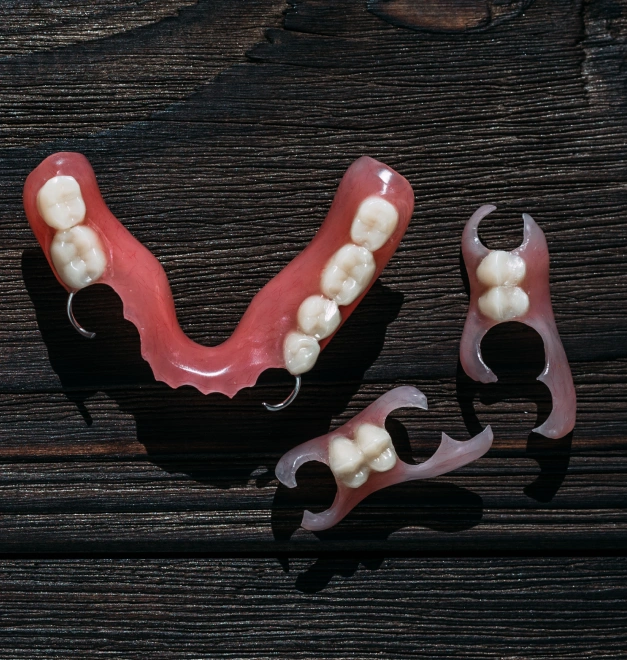
- Partial Dentures - A removable partial denture replaces multiple missing teeth in an arch where healthy natural teeth still remain. It consists of prosthetic teeth mounted on a metal or acrylic framework that attaches to the remaining natural teeth using clasps or precision attachments. The natural teeth provide support and stability for the partial, making it more secure than a full denture in most cases.
What to Expect During the Denture Process
Getting a custom denture at West McKinney Dental & Orthodontics is a multi-step process that takes place over several appointments. Each step builds toward a final result that fits properly, functions well, and looks natural.
01.
Initial Consultation and Evaluation
Our team conducts a thorough examination of your mouth, including the condition of any remaining teeth, your gum and bone health, and your bite. X-rays are taken to assess bone levels and identify any issues that need to be addressed before denture fabrication begins. We discuss your goals, your concerns, your lifestyle, and your budget, and walk you through the options that make sense for your specific situation. There is no pressure and no rush — this conversation matters.
02.
Treatment Planning and Extractions (If Needed)
If any remaining teeth need to be extracted before denture placement, this is planned and completed as part of the overall treatment sequence. Our team coordinates the timing carefully depending on whether conventional or immediate dentures are being made.
03.
Preliminary Impressions
Impressions of your mouth are taken to create study models that the dental laboratory uses as a starting point for designing your denture. These initial impressions capture the basic shape of your arches and the relationship between your upper and lower jaw.
04.
Bite Registration and Shade Selection
Records are taken to establish the correct vertical dimension — how far apart your upper and lower jaws should be when closed — and the proper relationship between the two arches. Prosthetic tooth shade and shape are selected at this stage to ensure the final result looks natural and appropriate for your facial structure and complexion.
05.
Wax Try-In
A wax model of the denture with the prosthetic teeth set in their intended positions is fabricated and placed in your mouth for evaluation. This is one of the most important steps in the process. The wax try-in allows our team and the patient to evaluate the fit, the bite, the tooth position, and the overall appearance before the final denture is processed in acrylic. Adjustments to tooth position, shade, or shape can be made at this stage without starting over. Patients are encouraged to look carefully, ask questions, and speak up if anything does not look or feel right.
06.
Final Denture Delivery
Once the try-in is approved, the dental laboratory processes the final denture in durable acrylic resin. At the delivery appointment, our team seats the finished denture, evaluates the fit and bite carefully, and makes any necessary chairside adjustments. Instructions for wearing, cleaning, and caring for the denture are provided before you leave.
07.
Follow-Up Adjustments
It is very normal and expected for a new denture to require adjustment appointments in the weeks following delivery. Sore spots, minor pressure points, and bite refinements are common and are addressed at follow-up visits. These adjustments are a standard part of the process, not a sign that something went wrong. Our team schedules follow-up appointments proactively and encourages patients to call any time something is causing discomfort rather than waiting.
Caring for Your Denture
A well-cared-for denture lasts longer, fits better, and is more hygienic. Daily care is straightforward and takes only a few minutes.
Daily care includes:
- Removing the denture after meals and rinsing it under running water to remove food debris
- Brushing the denture once daily with a soft denture brush and a non-abrasive denture cleaner — regular toothpaste is too abrasive and can scratch the acrylic surface, creating microscopic grooves where bacteria accumulate
- Brushing the gums, tongue, and roof of the mouth with a soft toothbrush each morning before inserting the denture to stimulate circulation and remove plaque from the oral tissues
- Soaking the denture overnight in a denture cleaning solution or plain water to keep the acrylic from drying out and warping
- Handling the denture carefully over a folded towel or basin of water — acrylic dentures can crack or break if dropped on a hard surface
Ready to Restore Your Smile?
Whether you are considering dentures for the first time, need to replace an existing denture that no longer fits, or simply want to understand all of your tooth replacement options, our team is here to help. We will take the time to listen, evaluate your situation thoroughly, and give you honest answers about what will work best for you.
New patients welcome. We see patients at every stage of their restorative journey.
Frequently Asked Questions
Q. How long does it take to get dentures?
The timeline varies depending on the type of denture and whether extractions are needed. For conventional full dentures following extractions, the process from initial consultation to final delivery typically takes three to six months, including healing time after extraction. Immediate dentures can be placed on the same day as extractions. Partial dentures without extractions generally take four to six weeks from the first impression to final delivery. Our team will give you a realistic timeline at your consultation based on your specific situation.
Q. Do dentures look natural?
Modern dentures are designed to closely resemble natural teeth and gum tissue. Prosthetic teeth are available in a wide range of shades, shapes, and sizes, and our team selects them carefully to complement your facial features and complexion. A well-made, properly fitted denture is typically not recognizable as a denture by others. The try-in appointment specifically exists to evaluate appearance before the final denture is processed.
Q. Will I be able to eat normally with dentures?
Most patients are able to eat a wide variety of foods with dentures, though there is an adjustment period. Starting with softer foods and working up to more challenging textures over the first few weeks is the recommended approach. Very hard, sticky, or extremely chewy foods may always require some caution. Implant-supported dentures offer significantly better chewing efficiency than conventional dentures for patients who want the most functional result.
Q. Can I sleep with my dentures in?
Most dental professionals recommend removing dentures at night to give the underlying gum and bone tissue a rest from the pressure of the appliance. Sleeping in dentures has been associated with increased risk of gum tissue irritation, bone resorption, and oral infections. Our team will provide specific guidance at your delivery appointment.
Q. How do I handle a broken denture?
Contact our office as soon as possible. Do not attempt to repair a broken denture with household adhesives — these products are not safe for use in the mouth and can damage the acrylic surface, making a proper professional repair more difficult. In many cases, a broken denture can be repaired relatively quickly. If it cannot, we will discuss the most appropriate next step.
Q. My existing denture no longer fits well. What should I do?
Come in for an evaluation. A poorly fitting denture causes sore spots, affects chewing efficiency, and accelerates bone loss in the underlying jaw. In many cases, a reline can restore the fit without a full replacement. Do not use over-the-counter denture adhesive as a permanent fix for a loose denture — it masks the problem without addressing it and can actually accelerate bone loss if used excessively.
Q. Are dentures covered by dental insurance?
Many dental insurance plans provide partial coverage for dentures, typically with a frequency limitation on how often they will contribute to replacement. The extent of coverage varies significantly by plan. Our team verifies your benefits before treatment begins and provides a clear cost breakdown so you know exactly what to expect. We will also discuss flexible payment options if needed.
Q. What is the difference between a removable partial and a dental bridge?
Both replace missing teeth but in different ways. A dental bridge is a fixed restoration anchored to the natural teeth on either side of the gap — it does not come out and is cared for like a natural tooth. A removable partial denture is taken out for cleaning and sleeping. Bridges are generally preferred when only one to three consecutive teeth are missing and the adjacent teeth are healthy. Partials are better suited for patients with multiple missing teeth spread across the arch or when the adjacent teeth are not suitable for crown preparation. Our team will discuss which option is appropriate for your specific situation.
Q. What are implant-supported dentures and are they worth it?
Implant-supported dentures attach to dental implants placed in the jawbone, providing significantly more stability, better chewing function, and greater long-term bone preservation than conventional dentures. They are a meaningful upgrade for patients who can undergo implant surgery, though they involve a higher upfront investment and a surgical component. For many patients, the improved quality of life is well worth it. Our team will evaluate whether you are a candidate and walk you through the comparison honestly.
Q. Can I get dentures if I have never had them before and still have some teeth?
Yes. Many patients transition to dentures while still retaining some natural teeth. Whether those remaining teeth need to be extracted before a full denture or retained to support a partial denture depends on their condition and strategic value. Our team evaluates every tooth individually and makes recommendations based on what will produce the best long-term outcome for your overall oral health — not a blanket approach.